Why Modest Swimwear Wears Out Faster in Chlorine and What Slows It
Quick Answer: Chlorine degrades elastane by breaking the bonds that give it recovery, and the damage is a function of exposure area and time, not just swim count. Modest swimwear has two to three times the fabric area of a standard suit, so each swim delivers more total degradation - and the first failures appear at high-stretch, high-friction points like the underarm, waist seam, and knee. Rinse in cold water within minutes, dry flat in shade, and rotate two suits.
The fabric is not worse. There is simply more of it in the water.

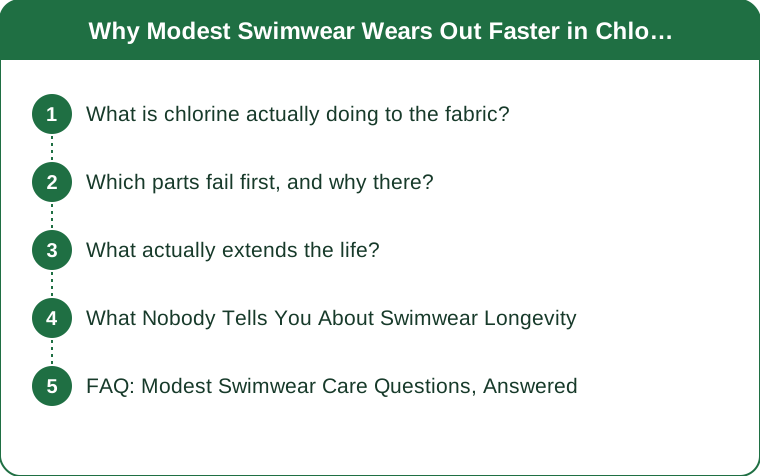
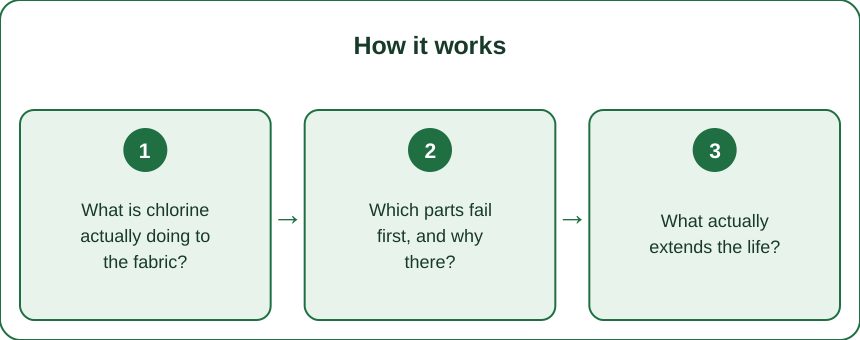
What is chlorine actually doing to the fabric?
Attacking the stretch fibre specifically, while leaving the rest largely intact.
Swim fabric is typically a blend - a base of nylon or polyester for strength, plus elastane (also sold as spandex or Lycra) at somewhere between 10 and 25 percent for stretch and recovery. Chlorine is an oxidizing agent, and elastane is far more vulnerable to it than nylon or polyester.
What happens: chlorine breaks the chemical bonds within the elastane’s segmented structure. Those bonds are what let the fibre return to length after stretching. Break enough of them and the fibre stretches but does not recover. The fabric does not tear - it goes slack, then sheer, then baggy.
The visible progression, in order:
- Slight loss of snap - the fabric feels softer and less springy
- Bagging at high-stretch points - seat, knees, elbows, underarm
- Transparency when wet and stretched, as yarn spacing widens
- Colour fade, which is a separate chlorine effect on the dye
- Visible fibre breakdown, a fuzzy or crepe-like surface texture
Why coverage changes the arithmetic. A modest swim set - full-length leggings, a long tunic or top, sometimes a swim cap - can be two to three times the fabric area of a one-piece. Chlorine damage is a function of exposed surface area and contact time. Twice the fabric in the pool for the same 40 minutes means roughly twice the total elastane degradation per session, spread across a garment you paid more for.
Heat compounds it. Warm pools accelerate the reaction. Hot tubs are dramatically worse - high temperature plus high chlorine concentration is the single fastest way to destroy swimwear, and 20 minutes in a hot tub can do more damage than several pool sessions.
Which parts fail first, and why there?
The places with the most stretch, the most friction, or the least rinsing - and modest swimwear has more of all three.
Underarm and shoulder seam. Every stroke cycles this area through its full stretch range. On a long-sleeved swim top this is the highest-repetition stress point in the garment, and it usually goes first.
Waistband and drawcord channel. A doubled or elasticated waist holds water and chlorine after you leave the pool, so it keeps reacting long after your swim ends. Anywhere the fabric is doubled is a chlorine reservoir, and folded hems, waistbands, and seam allowances all qualify.
Knees and seat on swim leggings. Repeated flexion plus contact with pool edges and ladders. The friction against rough concrete edges is genuinely destructive - poolside surfaces are abrasive by design, for grip.
Inner thigh. Fabric-on-fabric abrasion during kicking, which modest suits have and briefs do not.
Neckline and headscarf edge. Constant small movement plus, often, sunscreen. Sunscreen and body oils degrade elastane independently of chlorine, and the neckline is where they concentrate.
Anywhere it was folded while damp. Storing a suit folded in a bag while wet concentrates chlorine along the fold line, and the crease becomes the failure line.
A useful implication: because failure is localized rather than general, a modest swim set often fails in one component while the rest is fine. Buying separates rather than a fused one-piece set means replacing the leggings without replacing everything, which materially changes the cost per year.

What actually extends the life?
Six habits, in rough order of effect.
1. Rinse within minutes, in cold water. This is by far the biggest lever. Chlorine keeps reacting as long as it is in the fabric, so a suit that sits damp in a bag for an hour takes far more damage than the swim itself caused. Rinse thoroughly in the changing room - not a quick splash, a proper soak-and-squeeze. Cold, not warm, since heat accelerates the reaction you are trying to stop.
2. Pre-soak before swimming. A suit soaked in clean water before entering the pool absorbs less chlorinated water, because the fibres are already saturated. It sounds marginal and it measurably helps.
3. Dry flat, in shade, never in a machine. Tumble dryer heat is catastrophic for elastane, and direct sun combines UV degradation with heat. Flat on a towel indoors, turned once, is ideal. Hanging a heavy wet modest set stretches it under its own weight, which is why flat matters more here than for a light one-piece.
4. Rotate two suits. Elastane needs recovery time between wears to return to length. Alternating two suits more than doubles the life of each - it is the same principle as rotating shoes, and it is the most cost-effective thing on this list over a year.
5. Choose chlorine-resistant fabric for frequent swimming. Polyester-based fabrics such as PBT, and branded chlorine-resistant blends, last several times longer than standard nylon-elastane in a chlorinated pool. They are stiffer and less soft, which is a real trade-off, but for anyone swimming more than twice a week the durability difference is decisive. Check the composition label rather than the marketing copy.
6. Skip the hot tub in your good suit. Keep an old set for it. Nothing else destroys swimwear as fast.
What not to do: no fabric softener, which coats and degrades the fibres; no wringing, which permanently distorts the knit; no detergent beyond a mild rinse, since ordinary laundry detergent is harsher than the swim needs; and no storing damp, ever.
What Nobody Tells You About Swimwear Longevity
Sunscreen may be doing as much damage as chlorine. Oils and some UV-blocking compounds break down elastane and stain light fabrics permanently. Apply well before dressing, let it absorb fully, and rinse the suit especially thoroughly after an outdoor swim.
Saltwater is gentler than chlorine but not harmless. Salt crystals are abrasive as the fabric dries, and sand at the seams acts like sandpaper. The rinse rule applies equally at the beach.
Compression suits fail faster than relaxed-fit ones. Higher constant tension on the elastane means faster loss of recovery. A relaxed modest set often outlasts a compressive one at the same fabric quality.
Colour is a wear indicator. Fading is chlorine acting on the dye, and it tracks the elastane damage you cannot see. A noticeably faded suit has usually lost significant recovery already.
Darker colours hide transparency longer. Not a durability difference - a visibility one - but it extends the usable life of a suit that is technically past its best.
The price-per-swim calculation favours the better fabric. A chlorine-resistant modest set at twice the price that lasts four times as long is straightforwardly cheaper, and for regular swimmers the gap is wide enough that it is not a close call.
Pool chemistry varies enormously. Some pools run high chlorine and warm water, which is a punishing combination. If one pool destroys suits and another does not, that is real and not your imagination.
FAQ: Modest Swimwear Care Questions, Answered
How long should a modest swim set last?
With regular chlorinated swimming and standard nylon-elastane, three to six months of frequent use. Chlorine-resistant fabric with good care extends that substantially.
Can I machine wash it?
Occasionally, cold, on delicate, in a mesh bag, with no softener. Hand rinsing after every swim is what matters; machine washing is not a substitute for it.
Does the chlorine-neutralizing swimwear wash actually work?
They neutralize residual chlorine and can help, but a thorough immediate cold rinse achieves most of the benefit for free.
Why does my suit smell of chlorine even after washing?
Chlorine binds into the fibres, particularly in doubled areas like waistbands. A soak in cold water with a little white vinegar, then a thorough rinse, usually clears it.
Is it worth buying two suits at once?
Yes. Rotating two more than doubles the life of each because elastane recovers between wears. It is the cheapest life-extension available.
TL;DR:
- Chlorine attacks elastane specifically, and modest swimwear puts two to three times the fabric area in the water per swim.
- Failure is localized: underarm, waistband, knees, inner thigh, and anywhere the fabric is doubled and holds chlorine.
- Rinse in cold water within minutes - the biggest single factor by a wide margin.
- Dry flat in shade, never tumble dry, and rotate two suits to more than double the life of each.
- For frequent swimming, chlorine-resistant polyester blends outlast standard nylon-elastane several times over.
Rinse before you leave the changing room. Everything else is secondary to that.
See It in Motion
Seen here: High Waist Embossed Yoga Leggings with Side Pockets — shop it on bubblelime.com
Keep Reading
This article is for general informational and styling purposes only. Fit, sizing, and product availability may vary.