Why Does Modest Activewear Sizing Run Different From Standard Activewear?
Quick Answer: Modest pieces cover more joints, so a single size has to accommodate movement at the shoulder, elbow, hip, and knee simultaneously. Brands solve that by adding ease somewhere — usually the torso or the sleeve — which is why your standard size can be right in the shoulders and wrong everywhere else.
The number on the label is answering a different question than it does on a tank top.
This is the fix, and it is mostly about measuring the right three things.
This is general information, not medical advice.
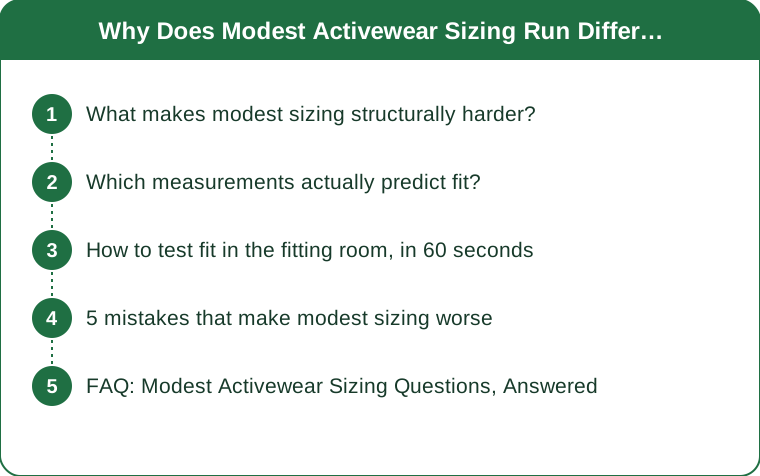
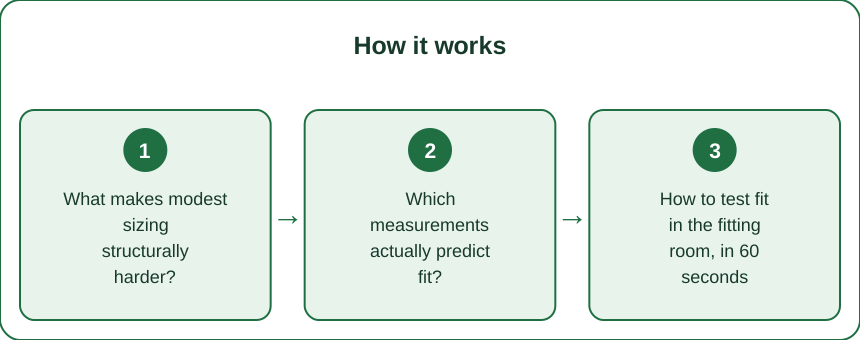
What makes modest sizing structurally harder?
Coverage means the garment crosses more joints, and every joint it crosses adds a constraint.
A cropped tank spans one joint region and can be cut close everywhere. A long-sleeve tunic spans shoulders, elbows, and hips, and each of those has to allow full range. The pattern has to satisfy three moving parts with one set of measurements, and there is no size number that does that for every body.
So brands make a choice. Some add ease through the torso, which is why a modest top that fits your shoulders can feel tent-like at the waist. Some add it in the sleeve and armhole, producing sleeves that fit but drop-shoulder seams that slide when you reach up. Some keep the cut close and rely entirely on four-way stretch, which fits beautifully until you wash it a dozen times.
None of these is wrong. They are different trade-offs, and knowing which one a brand made tells you more than the size chart does.
Why does the same size vary so much between modest brands?
Because the trade-off differs, and because modest lines are often designed off a different fit model than the same brand’s standard range. Consistency within a brand is usually good; across brands it is close to meaningless.
Which measurements actually predict fit?
Not bust and waist. Those get you into the right neighborhood and no further.
The three that predict modest activewear fit:
1. Shoulder-to-wrist with a bent elbow. Measure with the arm bent at 90 degrees, from the shoulder point over the elbow to the wrist. This is longer than a straight-arm measurement by several centimetres and it is the length the sleeve actually has to cover during any pressing or reaching movement. Sleeves that ride up mid-workout were fitted straight.
2. Torso length from shoulder to hip crease. For tunics and longline tops, this decides whether the hem sits where you want it or lands in a spot that shifts every time you move. High-hip and low-hip people wearing the same dress size need different lengths and rarely get them.
3. The full-reach test measurement. Stand with arms fully overhead and have someone measure your torso from shoulder to hip in that position. It will be 4 to 8 cm longer than at rest. That difference is what the garment must absorb, and it is the number that explains almost every complaint about hems riding up.
What about the size chart on the site?
Use it, then check the garment’s flat measurements if the brand publishes them. Flat measurements are objective; size charts are aspirational.
How to test fit in the fitting room, in 60 seconds
Standing still tells you nothing. Four movements tell you everything.
Overhead reach. Both arms straight up. Watch the hem. If it lifts more than a few centimetres, the torso is short for you and no amount of tucking will fix it during a workout.
Cross-body reach. Reach your right hand to your left shoulder. Tight across the upper back means the armhole is cut too close, which will restrict every pressing and rowing movement.
Deep squat. All the way down. Check three things: the waistband staying put, the seat fabric not going sheer, and the leg hem not climbing above where you want it.
Neckline check, head down. Look at the floor, then turn your head side to side. A neckline that sits fine standing straight can open considerably when the head drops — which is the position you spend most of a floor-based workout in.
Sixty seconds, and it catches almost everything that shows up two weeks later as a piece you stopped wearing.
Should I size up if it fails one of these?
Often no. Sizing up usually adds width when the problem was length, and you end up with a garment that is loose everywhere and still rides up. Look for a different cut or a brand with a longer torso block instead.
5 mistakes that make modest sizing worse
1. Buying the same size across brands. Modest lines vary more than standard activewear does, because the pattern trade-offs vary more. Assume nothing carries over.
2. Sizing up for coverage. A larger size adds circumference, not length — and looser fabric moves more during activity, which usually reduces coverage rather than improving it. Coverage is a cut problem.
3. Ignoring the layer underneath. If you wear a base layer under everything, fit the outer piece over it. Trying things on bare and then adding a layer at home is how a well-fitting top becomes a tight one.
4. Judging stretch fabric on day one. Four-way stretch relaxes with wear and recovers with washing, and the balance between those two shifts over a garment’s life. A piece that fits perfectly at purchase and loosely by week three was cut close and relying on recovery it did not have.
5. Forgetting the seasonal layer. A tunic that fits over a light summer base fits differently over a fall long-sleeve. If you buy in August for a wardrobe you will wear in November, try it with the thicker layer or accept the piece is a summer one.
FAQ: Modest Activewear Sizing Questions, Answered
Should I buy my normal activewear size in a modest line?
Start there, and expect to adjust. If you are long in the torso or long in the arms, expect to need either a size up or a brand with a longer block — and note that those two solutions are not equivalent.
Why do sleeves ride up on some tops and not others?
Armhole construction. A raglan or set-in sleeve with a properly shaped cap allows the arm to lift without dragging the body of the garment. A drop-shoulder looks relaxed and pulls the whole top upward when you reach.
Is a longer tunic always more coverage?
Not during movement. A long, loose tunic can shift and lift more than a shorter fitted one that stays put. Length at rest and coverage in motion are different measurements.
How do I know if a piece will stay opaque?
The squat test under bright light is the only reliable check. Fabric weight in grams per square metre, if published, helps — heavier generally means more opaque — but weave and colour matter too, and light colours over stretch almost always test worse.
Do modest pieces need a different size after washing?
Quality four-way stretch should recover close to its original dimensions. If a piece is noticeably looser after a few washes, it was under-specified for activewear, and sizing down next time is unlikely to solve it — the recovery is the problem, not the size.
TL;DR:
- Modest cuts cross more joints, so brands add ease somewhere — torso, sleeve, or stretch — and that choice defines the fit.
- Measure bent-elbow arm length, shoulder-to-hip-crease torso length, and your overhead-reach torso length.
- Test with overhead reach, cross-body reach, deep squat, and a head-down neckline check.
- Sizing up adds width, not length, and usually reduces coverage during movement.
- Try pieces with the base layer you actually wear, in the season you will wear them.
The size number is not the problem. It is being asked to solve a geometry problem it was never designed for, and three measurements take the guesswork out of it.
This is general information, not medical advice.
See It in Motion
Seen here: High Waist Drawstring Wide Leg Yoga Pants with Pockets — shop it on bubblelime.com
Keep Reading
This article is for general informational and styling purposes only. Fit, sizing, and product availability may vary.