Why Your Modest Layers Start Clinging the Moment the Air Turns Dry
Quick Answer: Static cling is a dry air problem, not a fabric defect. Synthetic fibres exchange electrons when rubbed together, and in humid air the moisture film on fibre surfaces conducts that charge away almost immediately. When indoor relative humidity drops below roughly 40 percent — which happens as soon as heating comes on — the charge stays put and layers cling. Fixes: raise indoor humidity, break up all-synthetic stacks with a natural fibre layer, and skip the dryer.
All summer the tunic sat over the leggings and moved the way it was supposed to.
First cold week, the heating goes on, and now it rides up your thigh and stays there like it has been glued.
The garments did not change. The air did.

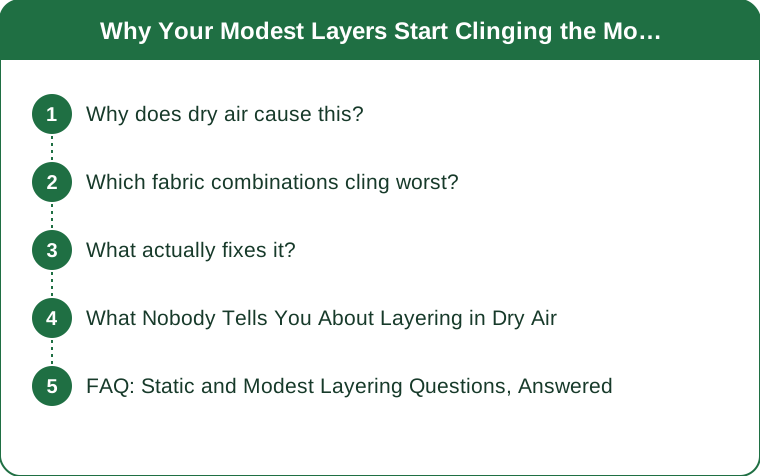
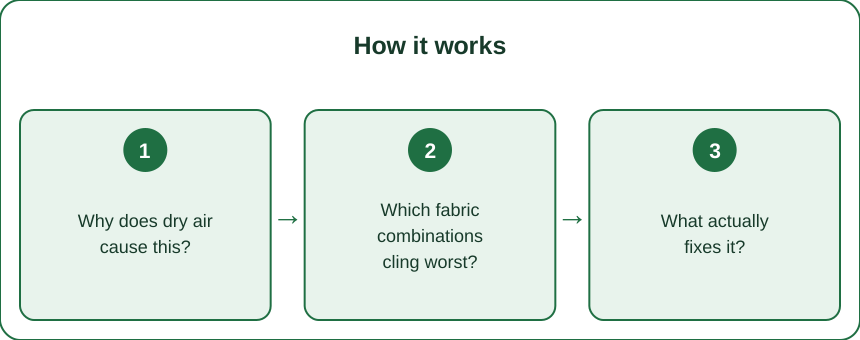
Why does dry air cause this?
Because humidity is what has been quietly draining the charge all summer.
Friction between dissimilar materials transfers electrons. Polyester rubbing against nylon, or fabric against skin, leaves one surface positively charged and the other negatively charged. This happens constantly, in every season.
Moisture in the air conducts the charge away. At higher relative humidity a thin film of water molecules sits on fibre surfaces, and that film is conductive enough to neutralise the charge as fast as it builds.
Below about 40 percent relative humidity, that film disappears. Charge accumulates instead of dissipating, and the two oppositely charged layers attract each other physically. That is the cling.
Heating dries indoor air dramatically. Cold outdoor air holds little moisture; heat it to 21°C indoors and the relative humidity can fall to 20 to 30 percent. This is why the problem starts the week the heating comes on, not the week it gets cold.
Synthetic layering stacks are the worst case. Modest activewear frequently means two or three layers, often all synthetic, all rubbing against each other. Each interface is a charge generator.
Fabric softener residue and dryer heat make it worse. Tumble drying is friction plus heat plus dryness — the ideal charge-generating environment. Most cling is created in the dryer, not during wear.
Which fabric combinations cling worst?
The ones sitting furthest apart on the triboelectric series, which is a fairly predictable list.
Polyester against nylon is the classic offender. They sit on opposite sides of the series, so rubbing them together generates charge efficiently. A nylon-blend legging under a polyester tunic is the standard modest-layering cling combination.
Acrylic knits are among the worst. Popular for soft autumn jumpers, and a strong charge generator against almost everything.
Wool against synthetic is also strong. Wool sits at the positive end, most synthetics at the negative, so a wool cardigan over a poly base layer clings notably.
Cotton and viscose are close to neutral. They also hold moisture, which helps them dissipate charge. A cotton or modal mid-layer is the most effective single fix available.
Same-fibre layers cling far less. Two polyester layers generate much less charge against each other than polyester against nylon, because the electron affinity difference is small.
Fabric weight is not the variable people assume. A heavy fleece and a light tricot can both cling badly. It is the fibre pairing and the air, not the thickness.

What actually fixes it?
Environment first, laundry second, garment choices third. In that order of effectiveness.
Raise indoor humidity to 40 to 50 percent. A humidifier in the rooms you dress and sleep in eliminates most of the problem outright. It also helps skin, sinuses and sleep, so it does more than one job.
Stop tumble drying your layers. Air drying avoids the friction-and-heat combination that creates most of the charge, and it is better for elastane anyway.
If you must use a dryer, use wool dryer balls and remove items slightly damp. Slightly damp fabric holds enough moisture to dissipate the charge as it finishes drying on a rail.
Insert one natural-fibre layer into the stack. A cotton or modal base layer between two synthetics breaks the charge chain. This is the highest-impact garment change and often the only one needed.
Use a leave-in anti-static spray or a light mist of water on the inner layer. Effective, cheap, lasts a few hours. A diluted fabric conditioner spray works, though it will reduce wicking over time if you overuse it.
Moisturise your legs. Dry skin generates and holds charge readily. This sounds trivial and is one of the more reliable fixes for leggings riding up.
Choose a slightly heavier outer layer for the season. A heavier tunic or dress resists being pulled by static in a way a lightweight one cannot, purely on mass.
Seasonal note: the worst weeks are usually the first fortnight of heating season, before the household adjusts humidity, and again in deep winter. Setting up a humidifier in September rather than discovering the problem in November saves the whole season.
What Nobody Tells You About Layering in Dry Air
It is not a sign of cheap fabric. Expensive technical synthetics generate static just as readily. Fibre type and humidity decide it, not price.
Wicking layers can lose performance from anti-static treatments. Fabric softener and heavy conditioner sprays coat fibres and reduce moisture transport permanently. Use them sparingly on performance layers.
A metal hanger or safety pin genuinely works as an emergency fix. Running a metal object over the garment provides a discharge path. It is not folklore.
Layer order matters for movement, not just static. Smoother inner surfaces let outer layers glide. A brushed inner face grips, which compounds ride-up on top of the static.
Shoes contribute. Rubber soles insulate you from ground, so charge accumulates all day rather than draining. Leather soles discharge far more readily.
Static also attracts lint and pet hair. If your dark layers suddenly look dusty in October, that is the same phenomenon, and the same fixes solve it.
Hair and clothing are one system. If your hair is misbehaving in the same weeks, the room humidity is the shared cause and the humidifier fixes both.
FAQ: Static and Modest Layering Questions, Answered
What indoor humidity should I aim for?
Around 40 to 50 percent is generally comfortable and is enough to dissipate charge. Below 30 percent, cling becomes near-inevitable with synthetic layers.
Does fabric softener fix static?
It reduces it, and it also coats performance fabrics and reduces wicking. Use it on non-technical layers only, or use dryer balls instead.
Which base layer is best for reducing cling?
Cotton, modal or a merino blend. All three hold some moisture and sit near the neutral part of the series.
Why does it only happen in one outfit?
That combination probably pairs a nylon and a polyester or acrylic layer. Swapping one piece usually solves it entirely.
Is anti-static spray safe for activewear?
Occasional use is fine. Regular use on wicking layers will degrade moisture transport over time.
Does it get better later in the winter?
Usually no — it stays until humidity rises in spring, unless you add moisture to the air. That is why the humidifier is the real answer.
TL;DR:
- Static cling is dry air, not poor fabric. Below roughly 40 percent humidity, charge stops draining away.
- Heating is the trigger — cold outdoor air heated indoors can drop humidity to 20 to 30 percent.
- Polyester against nylon and acrylic are the worst pairings; same-fibre layers cling far less.
- Fix in order: humidifier, stop tumble drying, add one cotton or modal layer.
- Moisturise your legs — dry skin holds charge and is a genuine cause of ride-up.
Set the humidifier up in September, not November.
See It in Motion
Seen here: High Waist Embossed Yoga Leggings with Side Pockets — shop it on bubblelime.com
Keep Reading
This article is for general informational and styling purposes only. Fit, sizing, and product availability may vary.